When I first started looking for the best crochet hook for me, I had been using inexpensive aluminium hooks for years. I felt my crochet had progressed enough for me to invest in something better, but there were so many hooks to choose from, and I baulked at paying for a whole set without knowing what they would be like to work with. Luckily, a fairy godmother sent me a selection of hooks to try. I would like to share my findings with you so that I can help you choose the best crochet hook for you!

Choosing the Best Crochet Hook for You – Hook Anatomy and Reviews
Update 2026
I wrote this post more than a decade ago. Since then, I’ve spent thousands of hours crocheting, and although most of my original observations still stand, a few of my opinions have changed with experience.
The most important thing I’ve learnt is that there is no single ‘best’ crochet hook. What works beautifully for one person might be uncomfortable or frustrating for another.
In this post, I’ll walk you through the different parts of a crochet hook, explain what I look for when choosing one, and share my experiences with the hooks I’ve tried over the years.
Hopefully, this will help you find the best crochet hook for you!
This is quite a long post, so I created an index that lets you jump to the part you are most interested in.
Before We Start…
Before we start, I would like to point out a few things.
The five brands I originally focused on in this comparison are all tapered hooks. I don’t use inline hooks. I find that my gauge is much too relaxed when I use them (I would love to hear your opinion on this). If you want to find out more about inline hooks, have a look at this post by Planet June.
I also steered clear of crochet hooks with wooden or plastic shafts and heads, purely because I find aluminium hooks work best for me across a variety of yarns. Wooden or plastic hooks may, however, work better for certain yarns or crocheters.
If you want to find out about Boye and Susan Bates hooks, you might enjoy this post by Nerdigurumi.
Lastly, I crochet using the knife grip, so my crochet hook is nestled in my palm. When I first started comparing hooks, one of my main concerns was that I have very long hands. I didn’t want to end up with a hook that kept poking my palm as I worked! As it turns out, that concern was unfounded. Both Clover Amour and Tulip Etimo hooks have relatively short handles, yet I’ve used them comfortably for years.
Index
- Anatomy of a Crochet Hook
- Comparing the Different Hooks
- Looking at Each Hook Individually
- More Crochet Hooks
Anatomy of a Crochet Hook
Before we look at the different crochet hooks, I want to talk about the anatomy of a crochet hook. Each hook consists of a body and a head. The body is divided into a handle, thumb rest (optional), shaft, and throat. The head has a point (sometimes called a tip), a groove, and a lip.
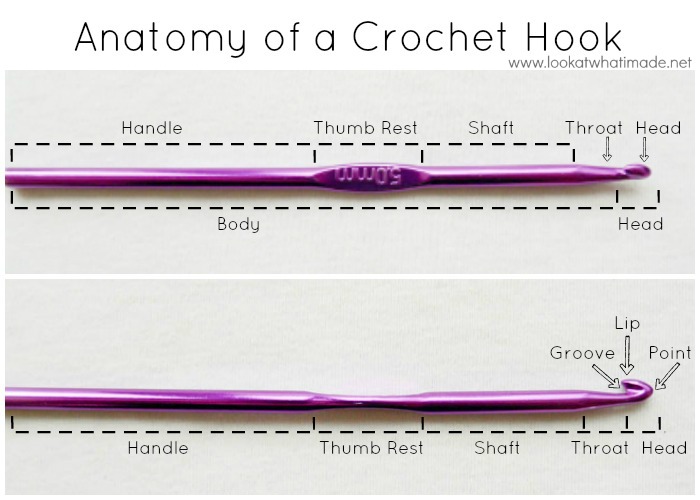
The handle of a crochet hook is the part that rests in your palm with a knife-grip, or against your index finger with a pencil-grip. The handle can be a continuation of the shaft, or it can be made from a completely different material. It may or may not include a thumb rest, and it can be the same size as the shaft (see the aluminium hook above and the Addi Premium hook below) or ergonomically shaped (like the Furls below).
The problem with an ergonomically shaped handle is that it might not suit every grip or hand. If you are thinking of buying an ergonomic hook, I suggest that you try before you buy. You can read more about ergonomic crochet hooks HERE.

Left: Addi Premium Bamboo Hook; Right: Furls Candy Shop Crochet Hook
The thumb rest is the part of the hook where you will rest your thumb while crocheting. If you have a hook with an ergonomic handle, the thumb rest will form part of the handle (if there IS a thumb rest).
Not all crochet hooks have a thumb rest. I much prefer hooks that DO have one, like Clover Amour and Tulip Etimo. I find that a well-defined thumb rest helps me position the hook comfortably and consistently in my hand.
The shaft is the part of the hook between the head and the handle/grip. Some hooks have a generous shaft, making it easy to create stitches that require a lot of ‘loading’ like Bobbles, Clusters, or the Bullion Stitch. Other hooks (like the Addi Swing) have a very short shaft, which can make longer stitches (like a triple treble) or cluster stitches more uncomfortable.
If you are choosing a hook with an ergonomic handle, it is also worth considering whether the shaft extends all the way to the end of the handle/grip, or is only ‘stuck’ into the top of the handle. Addi Swing and Addi Comfort Grip hooks are examples of shafts being ‘stuck’ into the handle. It is worth noting that things can go awry with both methods. Your shaft can either detach from your hook or poke through the handle (if you have a silicone handle). Neither is common, though!
There are two main types of crochet hooks: inline and tapered.
With inline hooks, the head is roughly the same width as the shaft. It almost looks like someone has made a chip or cut where the throat/groove should be, without touching the rest of the hook.
The throat on these hooks is about the same width as the shaft (when you look at the hook from the front), but it narrows significantly from front to back (when you look at the hook from the side).
With tapered hooks, the head protrudes slightly beyond the shaft, and the throat is more tapered. The throat is therefore thinner than the shaft, both from the front and from the side.
As I mentioned earlier, I prefer tapered hooks, but plenty of crocheters swear by inline hooks!

When you are looking at the head, there are three things to consider: Point, Groove, and Lip.
The point is the very tip of the hook. It can range from very rounded (blunt) to very sharp (pointy). I find that the easiest hooks to work with are semi-blunt. If the point is too blunt, it makes it hard to get into your stitches. If it is too sharp, it can split your yarn when you insert your hook. Sharp points are, however, perfect for things like working through fleece to add a border.
The groove can be either straight or rounded. I prefer rounded grooves because I think they ‘hold’ the yarn better. Hooks with rounded grooves also tend to have less ‘pointy’ lips, which helps to minimise splitting.
The lip is the actual ‘hook’ part of the crochet hook. I find that a rounded lip is almost always better than a pointy lip because a pointy lip has a tendency to snag on the stitches as you pull through.
If you have an inline hook, the head will generally be round (similar in size to the shaft), as with the Symfonie hook above. The lip will point straight down, and the groove will be deep and steep.
With tapered hooks, the head is generally more oval, with the lip overhanging the shaft. The groove on these hooks tends to be less deep than on inline hooks.
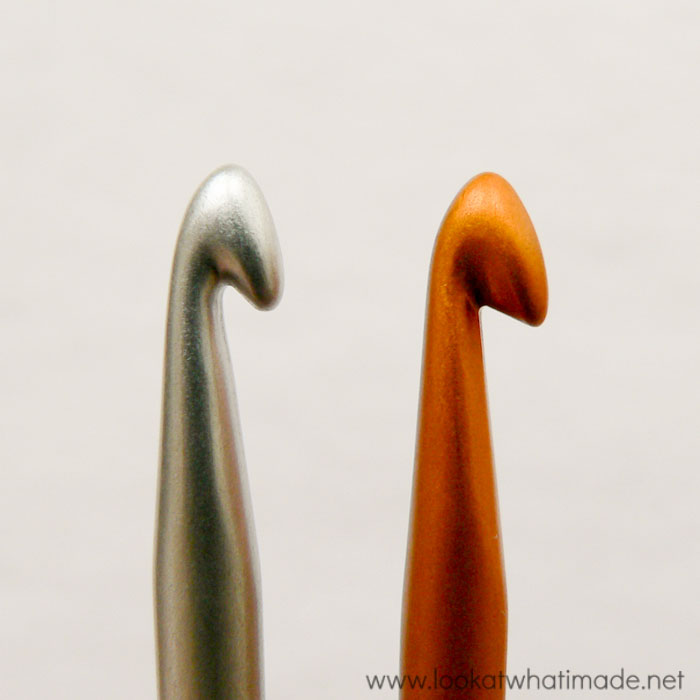
Left: Clover Amour (Rounded Groove); Right: Clover Soft Touch (Straight Groove)
Comparing the Different Hooks
When I originally tested the following hooks, I used each hook with cotton, acrylic, and wool. I also used a mix of simple stitches (specifically hdc’s, because they are most likely to split) and stitches that required ‘loading’ (see Shaft above). I actually used them to make parts of my prototype Sophie too, so they got a very good workout.
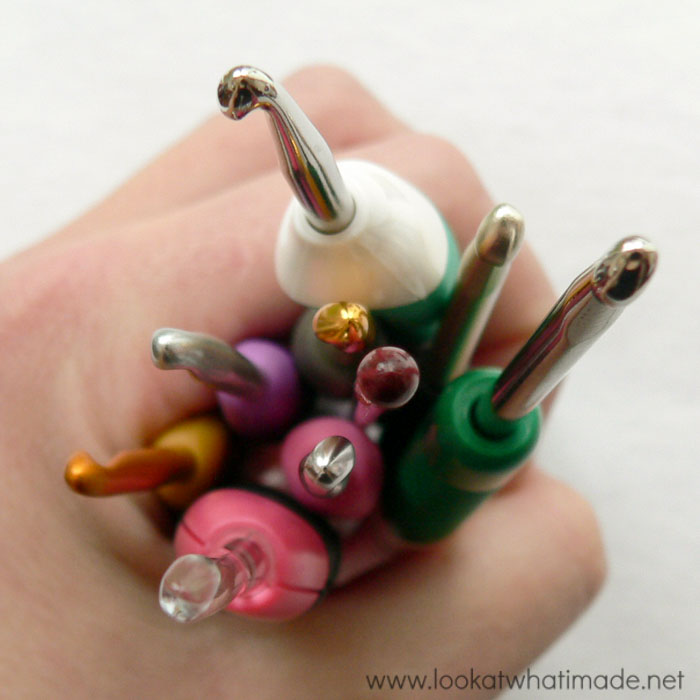
Size
As I mentioned earlier, hook length was initially a big concern for me. As it turns out, some of the shortest hooks were also the most comfortable!
I’ve included the measurements below for comparison, but don’t let length alone determine your choice. A hook’s shape and how it sits in your hand are far more important than a centimetre here or there.
| Brand/Make |
Length |
||
| Handle Length | Shaft and Head Length | Total Length | |
| TULIP Etimo Rose | 9.9 cm | 4.1 cm | 14 cm |
| TULIP Etimo Gold | 9.9 cm | 4.1 cm | 14 cm |
| Clover Amour | 10 cm | 4 cm | 14 cm |
| Clover Soft Touch | 9.5 cm | 3.7 cm | 13.2 cm |
| Addi Swing | 13.2 cm | 2.8 cm | 16.0 cm |
| Addi Comfort Grip | 11.7 cm | 4.3 cm | 16.0 cm |
| Prym | 9.5 cm | 4.3 cm | 13.8 cm |
| Corner Stone Crochet Lite | 11.6 cm | 4.0 cm | 15.6 cm |

Clover Crochet Hooks And Namolio Linen Crochet Hook Case
Colour and Feel
When I first shared this post, I said the colour of the handle probably isn’t a huge factor, but it is to me. I stand by that even more strongly now. Second only to comfort, colour is the most important thing about the hooks I choose. After years of working with Clover Amour, I know instinctively which colour corresponds to which hook size.
This is particularly useful when I photograph my projects. I often include the hook I’ve used in a photograph so that I can tell at a glance which size it was, even years later. No squinting at tiny numbers or trying to remember what I used!
And this is ultimately why I still reach for my Clover Amour hooks slightly more often than my Tulip Etimo hooks. In terms of comfort and performance, I find them equally lovely to use, but the different-coloured handles suit my brain better.
Some handles also feel and look less luxurious than others. Of all the handles, the Addi handles are my least favourite because of their generic plastic look.
For me, crochet is not just about making a blanket or a stuffed toy! It is about the feel of the yarn as it slips through your fingers. It is about the colour and the texture and the ambient sounds as you work. It is about pretty!! So when I hold my crochet hook and look at it, it should make me happy, not make me cringe.
| Brand/Make |
Colour |
|
| Handles | Shaft | |
| TULIP Etimo Rose | Shades of Pink | Silver |
| TULIP Etimo Gold | Grey | Gold |
| Clover Amour | Multicoloured | Matt Silver |
| Clover Soft Touch | Matt Gold | Matt Gold |
| Addi Swing | Multicoloured | Silver |
| Addi Comfort Grip | Multicoloured | Silver |
| Prym | Black | Silver |
| Corner Stone Crochet Lite | Multicoloured | Transparent Plastic |
Other Important Bits
Below is a ‘Miscellaneous’ table. Most of these things are just FIY, but the numbers/markings are worth noting.
| Brand/Make |
Miscellaneous |
||||
| Point | Groove | Thumb Rest | Handle/Grip | Numbers/Markings | |
| TULIP Etimo Rose | Slightly Pointed | Straight | Yes | Shaped | Clear Sticker |
| TULIP Etimo Gold | Slightly Pointed | Straight | Yes | Shaped | Clear Sticker |
| Clover Amour | Slightly Pointed | Rounded | Yes | Shaped | Engraved |
| Clover Soft Touch | Slightly Pointed | Straight | Yes | Flat | Printed |
| Addi Swing | Standard | Rounded | Yes | Curved (toothbrush) | Coloured Inlay |
| Addi Comfort Grip | Standard | Rounded | No | Cylindrical | Textured |
| Prym | Blunt | Rounded | No | Tapered Cylinder | Printed in White |
| Corner Stone Crochet Lite | Standard | Straight | Yes | Shaped Hard Plastic | Printed |
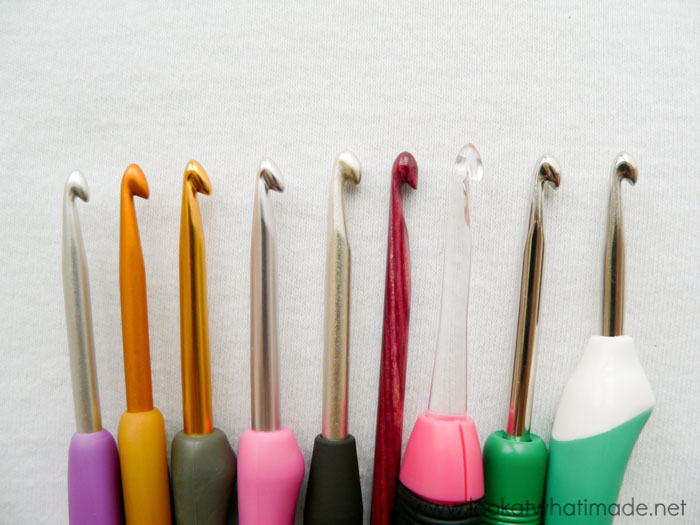
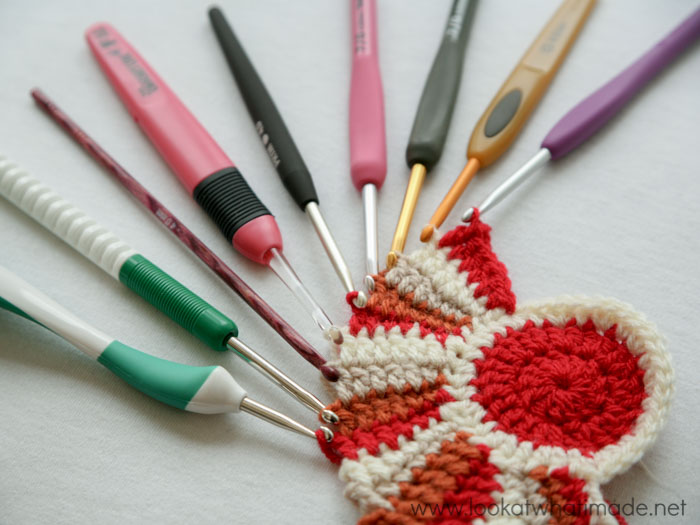
From Left to Right: Clover Amour, Clover Soft Touch, Etimo Gold, Etimo Rose, Prym, Inline, Corner Stone, Addi Comfort Grip, Addi Swing
The Prym and Tulip hooks, for example, sport their numbers as either stick-on (Tulip) or printed (Prym). When I originally wrote this post, I was concerned that these markings might wear away with time, leaving you to guess which size hook you were using.
I’m happy to report that, after almost a decade of using my Tulip Etimo Gold hooks, the size markings are still perfectly legible!
Yes, I know that you can use a knitting gauge to check your hook size, but a knitting gauge is round, which is great if you are using an inline hook with a round head, but not particularly useful if you are using a tapered hook with an oval head.
And I don’t want to sound like a broken record, but you don’t have this problem with multicoloured handles…
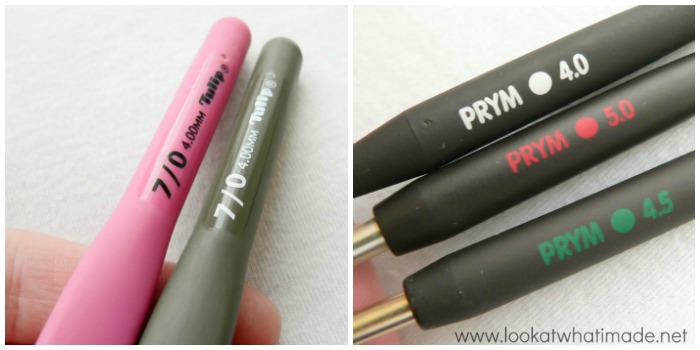
Left: Tulip Hooks; Right: Prym Hooks
Looking at Each Hook Individually
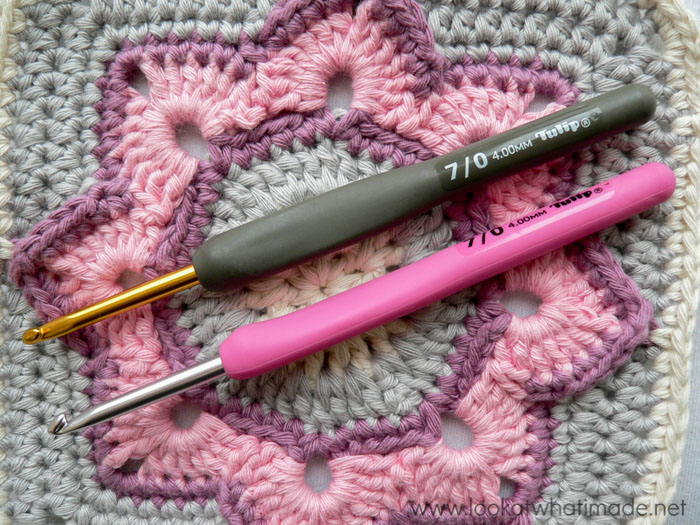
There are many things I love about Tulip hooks. I love the way they look, I love their uniform colour, and I love their cases!
When I originally reviewed these hooks, I didn’t find them quite as comfortable as the Clover Amour hooks. Almost a decade of using Tulip Etimo Gold hooks has changed my mind. I now find them every bit as comfortable as Clover Amour, and I genuinely enjoy working with both.
The hooks for both the Etimo Gold and the Etimo Rose are the same (except for colour). The hook is slightly pointed (like Clover Amour), and the groove is straight (almost like Clover Soft Touch, but more rounded). The shafts are shiny and can cause a little bit of ‘squeak’ with budget acrylics. The handles are comfortable in both knife and pencil grips, with a lovely, well-defined thumb rest.
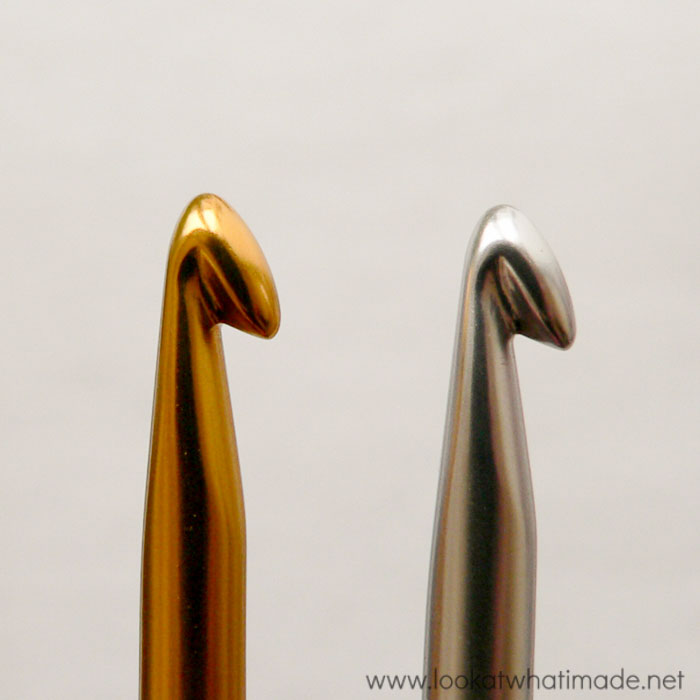
Left: Etimo Gold; Right: Etimo Rose
Buy Etimo Hooks:
You can buy the Etimo Gold hook set on Amazon (US/UK). You can buy the Etimo Rose hook set on Amazon (US/UK).
Clover Crochet Hooks And Namolio Linen Crochet Hook Case
Clover Amour hooks are still my favourites, although Tulip Etimo has certainly caught up with them in terms of comfort and performance!
Clover Amour
These hooks are my favourites for so many reasons. The handles are extremely comfortable, both in knife grip and pencil grip. They do have a tendency to get grubby, but are easily cleaned with soap and water. The thumb rest is the perfect size.
The head is slightly pointed (as with the Tulip and Clover Soft Touch hooks), so I don’t have trouble with splitting when inserting my hook. The lip is slightly rounded, so I don’t have trouble with splitting as I pull through. The groove is also slightly rounded (see Head above), so my stitches don’t accidentally slip off my hook like they do with the Clover Soft Touch hooks.
The shaft has a matte coating that I really like. It strikes the perfect balance between ease of use and friction. I like the fact that the numbers are engraved, so there is no danger of them ‘rubbing off’, and I LOVE the fact that each size has a different coloured handle.
One possible con is that the aluminium hook does not extend all the way to the base of the silicone handle, making the very end of the handle a bit flexible. There have been reports of the silicone tearing where the metal stops, especially if you put a lot of pressure on that bendy end. This hasn’t been a problem for me, though.
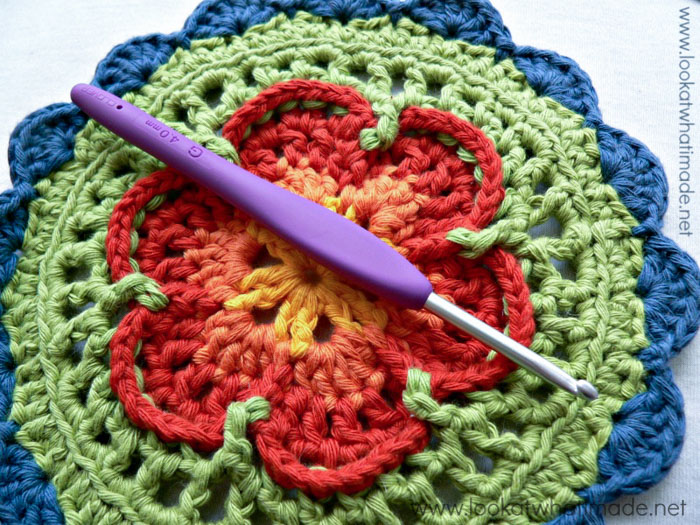
Clover Amour Hook and Part 1 of Sophie’s Universe
The large Clover Amour hooks have hard plastic heads and shafts, with neon silicone handles. They have a straight groove that’s slightly deeper than that of the Clover Soft Touch hooks. They do not squeak as you work, and the plastic has just the right amount of glide vs friction. They are extremely comfortable to work with, though projects you use them for will likely require more elbow grease due to the yarn’s thickness.
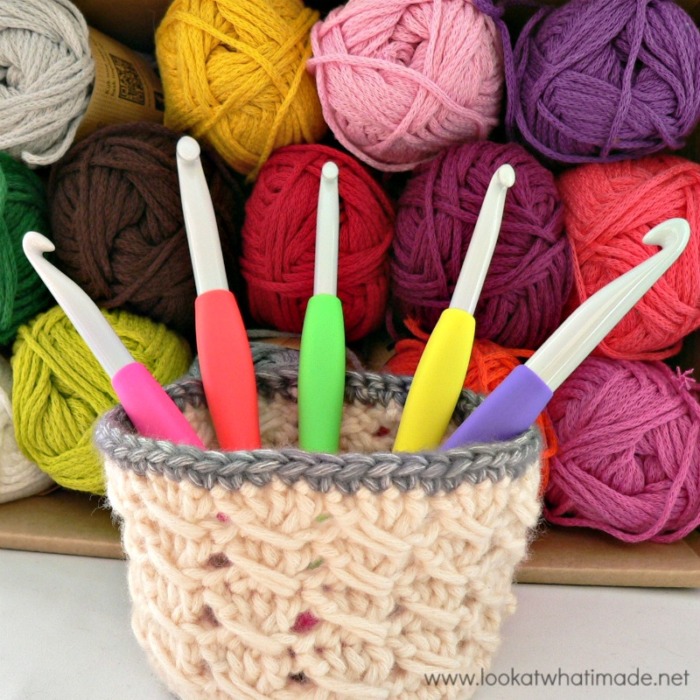
Clover Soft Touch
Although I like working with the Clover Soft Touch hooks (and used to use them as my fall-back hooks), I do not like the colour at all!! They are marginally shorter than the Amour hooks, but very comfortable when used with the knife grip (despite the ‘flatness’ of the handle). I do, however, find them uncomfortable to use in pencil grip.
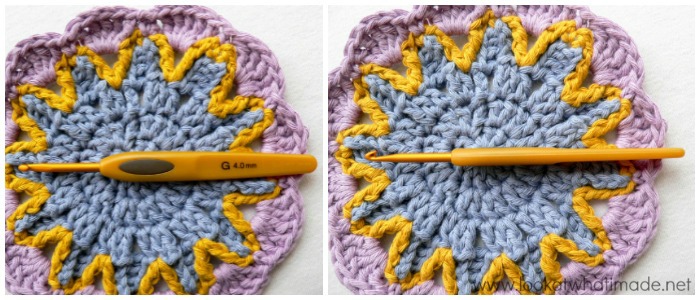
The numbers are printed on the hooks, which isn’t ideal when all the handles are the same colour. The lip is more pointed than the Clover Amour hooks, causing me to split my yarn more easily. The groove is also straight (see Head above), which means that I find myself accidentally removing my hook from the working loop. I do, however, think that they glide better than the Clover Amour hooks (but this might just be in my head).
Buy Clover Soft Touch Hooks:
You can buy the Clover Soft Touch hook set HERE in the US and HERE in the UK.
The heads of both the Addi Swing and the Addi Comfort Grip are the same. They have a shiny finish, a rounded lip, and a rounded groove. The points are a little bit more blunt than the Clover hooks. The Addi hooks tend to squeak a little when used with acrylic yarn, but they glide really well.
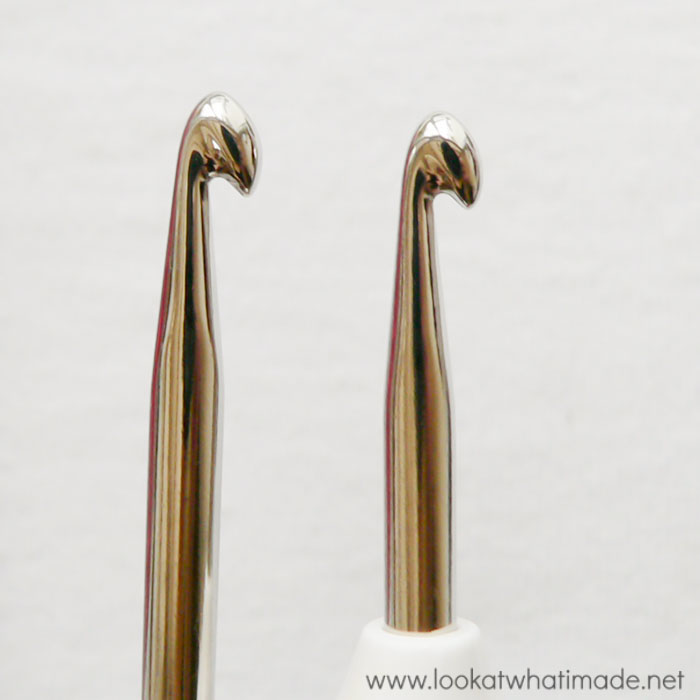
Left: Addi Comfort Grip; Right: Addi Swing
Addi Swing
Although the Addi Swing has a flowing shape, I don’t like their generic plastic look. The hooks are longer than the others, but they are not as comfortable as the Clover or Tulip hooks. I especially found them uncomfortable in the pencil grip. I like the fact that the handles are multi-coloured, though!
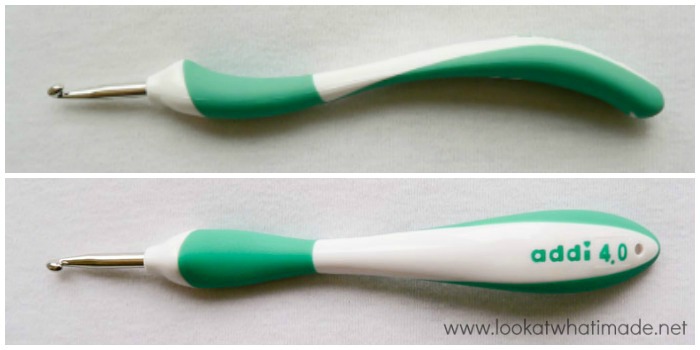
Although the hooks are longer than the others I tested, the shaft is actually the shortest, making it uncomfortable for stitches that require ‘loading’ (see Shaft above). The shaft is also stuck into the top of the plastic handle, and I have managed to loosen the shaft on one of my Addi Swing hooks.
Many people find these hooks really comfortable though, so if you are unsure, I suggest buying one in your favourite size and giving it a go. You just might LOVE it.
Buy Addi Swing Hooks:
You can buy the Addi Swing hook set HERE in the US (Set of 13) and HERE in the UK (Set of 7).
Addi Comfort Grip
I found the Addi Comfort Grip hooks to be the least appealing to look at. Having said that, they were comfortable enough to work with, and they also have multi-coloured handles. They don’t have thumb rests, so I had to adjust my grip marginally to get the head pointing in the right direction.
The head is the same as for the Addi Swing, but the shaft is 1.5 cm longer, making it easier to crochet stitches that require loading (see Shaft above).
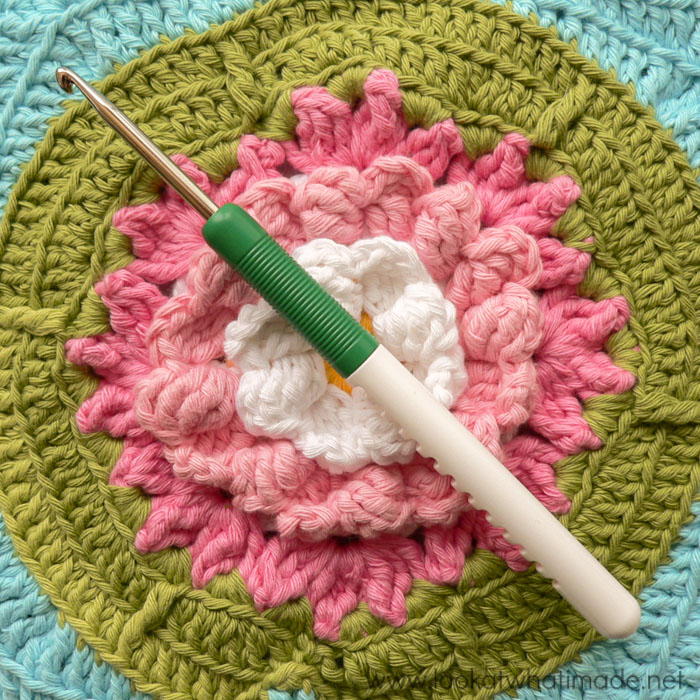
I tested the Prym Soft Handle hooks for this post. They are very comfortable to work with, even though they don’t have defined thumb rests. They are slightly shorter than the Clover and Tulip hooks, and the handle is a tapered cylinder. The point is blunt and wide, and the lip is blunt as well. If you crochet tightly, you might have trouble getting your hook into your stitches.
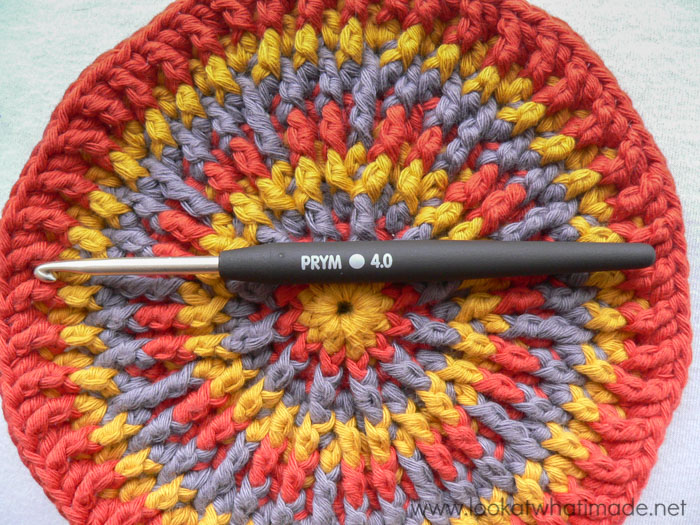
Prym Crochet Hook and Front Post Frenzy Crochet Potholder
Prym hooks have a rounded groove and a matte finish, both of which I really like. The numbers are printed, however, and have a bad habit of fading…
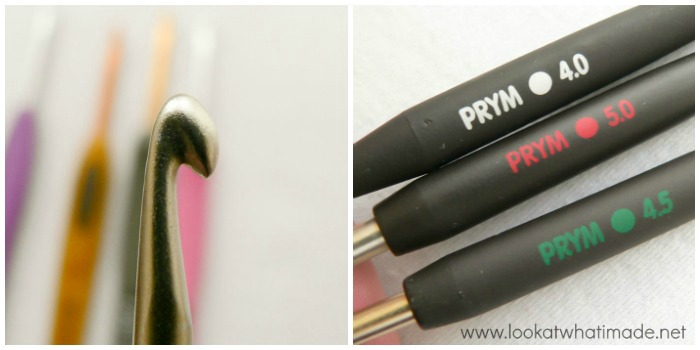
I was pleasantly surprised by how much I liked these hooks. I hadn’t expected to like them (at all!!!), but they were very comfortable to work with, especially given that the heads and shafts are plastic and have a shallow, straight groove.
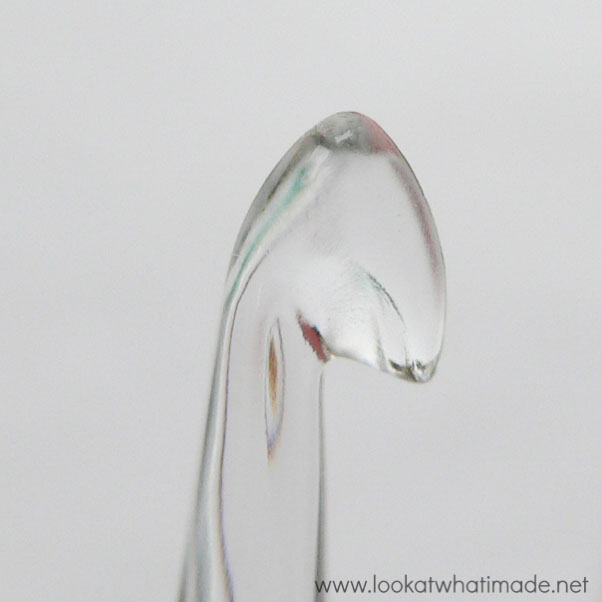
The numbers are printed on the hook, but the hooks do also have multi-coloured handles.
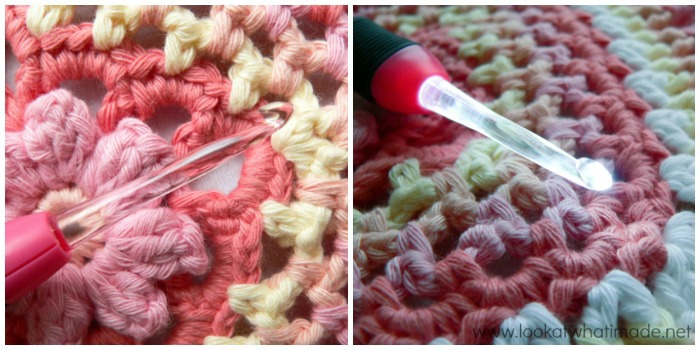
They feel slightly cheap, and the light is more of a gimmick than anything else, but I found myself oddly intrigued by how easy they were to use.
Buy Corner Stone Crochet Lite Hooks:
You can buy the Corner Stone hook set HERE in the US and HERE in the UK.
More Crochet Hooks
I wasn’t going to include this hook initially. It is an inline hook, for one, and it is made from wood! But I absolutely LOVED (!!!!) working with it.
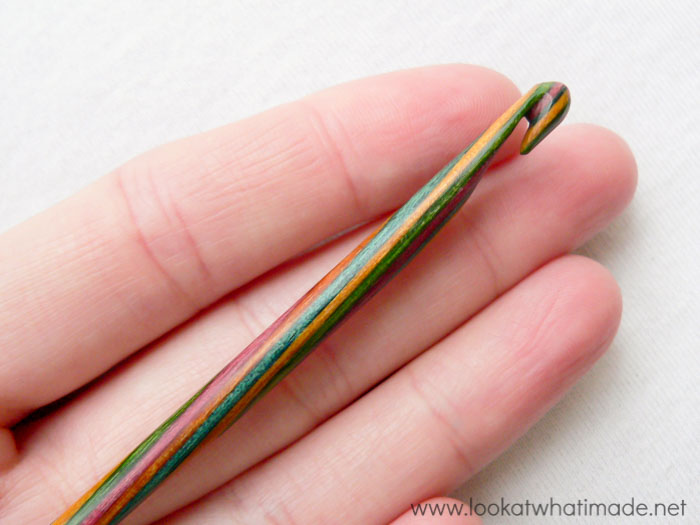
The head is rounded, the lip is pointy, and the groove is rounded and deep.
The hook feels wonderful to hold, even without a separate handle, and is beautiful to look at. It glides really well too.
The only issue I had was that my tension was miles off. Because it is an inline hook, I couldn’t crochet as tightly as I like to.
Buy Knit Pro Symfonie Hooks:
You can buy the Knit Pro Symfonie hook set HERE in the US and HERE in the UK.
I used to have a set of these that lived in my ‘work bag’. They were my go-to emergency hooks (for when I hadn’t packed the right size). They come in a handy plastic box and take up very little space.
I thought that they would be super uncomfortable, but they are actually really comfortable (in knife grip AND pencil grip). The heads and shafts are a shiny gold colour. The point and lip are both slightly pointed, and the groove is shallow. The handles are triangular and quite hard.
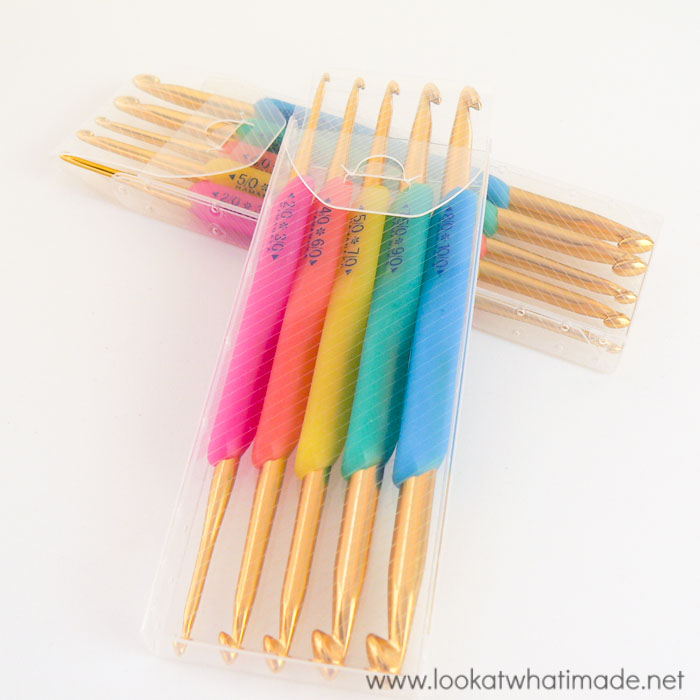
Hamanaka Raku Raku Crochet Hooks
My only problem with these hooks…well…my only 2 problems:
a) The hooks aren’t marked with metric sizes! You can get a conversion chart that tells you which number equals which metric size, but I never seem to have one handy.
b) It is super easy to accidentally start hooking with the wrong end of the double-sided hook. Whoops!
Buy Hamanaka Raku Raku Hooks:
You can buy the Hamanaka hook set HERE.
I have only bought one Furls Candy Shop hook. It cost more than both my sets of Clover Amour hooks combined, and at the time, I couldn’t say I thought it was worth that much!
The hook, shaft, and head are made from poly resin in one continuous piece and painted with several layers of shiny yumminess. The head is blunt, the lip is pointed, and the groove is straight.
It is an inline hook, and my 4 mm hook works up to the same gauge as my 4.5 mm Clover Amour.
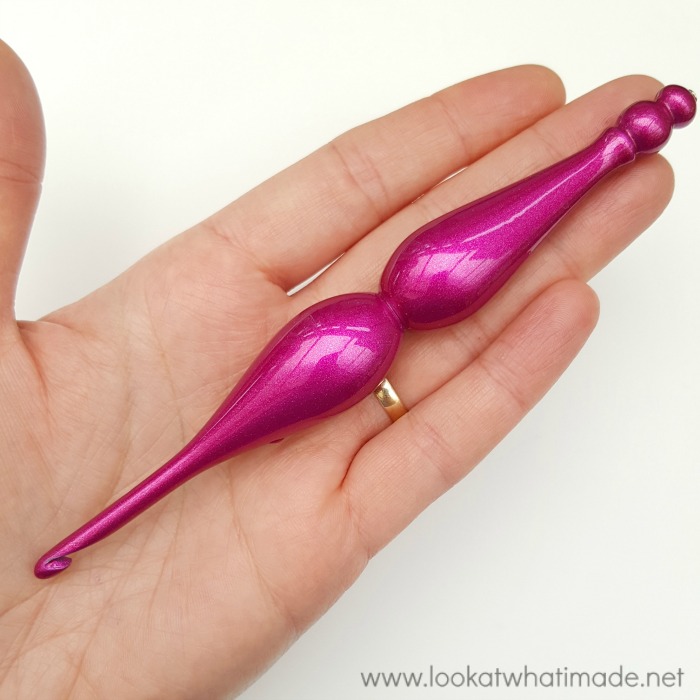
Furls Candy Shop Crochet Hook (4 mm)
The hook tends to squeak with budget acrylics, and the varnish started coming off at the very edges where the throat meets the head (that happened quite early on).
Although the handle is extremely comfortable (both in knife grip and pencil grip), it does take some getting used to.
Over the years, I’ve changed my mind about these hooks. As inline hooks go, they’re pretty lush! Once I resigned myself to the gauge difference, I thoroughly enjoy using mine.
And it is awfully pretty!!!
The Ilona Heritage Hook is a hand-crafted Rosewood hook from Yarn in a Barn. It feels absolutely amazing to hold! I often use mine as a stress reliever, compulsively spinning the silky-smooth hook in my hand. The hook is roughly a centimetre longer than the Candy Shop hooks, and I find it more comfortable to hold. It is an inline hook with a rounded groove. The point is very slightly rounded, and the lip is wide and blunt. I didn’t have any problems with my yarn splitting or squeaking. As with the Candy Shop hook, my gauge was more relaxed, but only marginally.
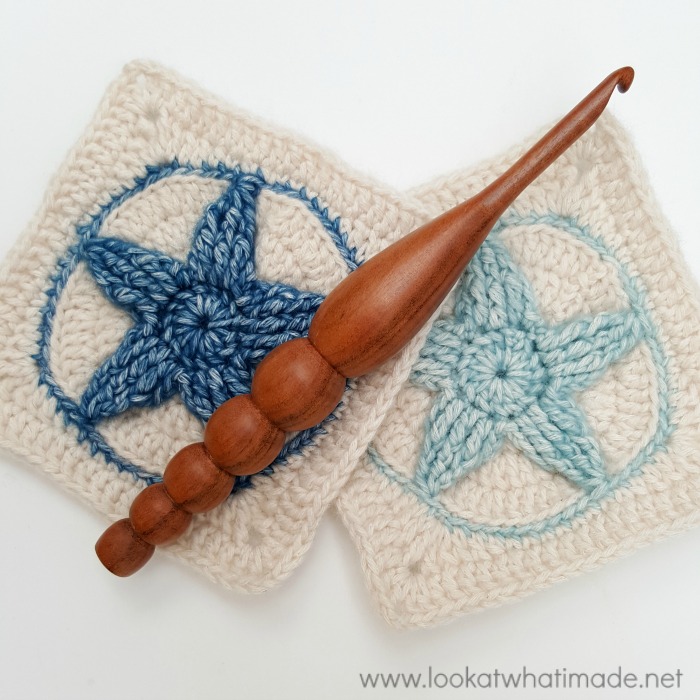
Ilona Heritage Hook and Starfish Squares (pattern in Issue 1 of ‘Yarn’)
I have a 5.5 mm Ilona and it is my favourite hook to use when I am crocheting to relax (as opposed to crocheting with furious purpose).
Alternative:
Unfortunately, these hooks are no longer available.
Final Thoughts
If there’s one thing I’ve learnt from trying all these different hooks, it’s that choosing a crochet hook is very personal.
The shape of the head, the length of the shaft, the feel of the handle, and even the colour can all affect how much you enjoy using it.
My preferences have changed a little over the years, and some hooks have surprised me enormously. The important thing is finding something that feels comfortable in YOUR hand and works well with the way YOU crochet.
If you’re considering investing in a new set, I’d suggest trying one hook in a size you use frequently before committing to the whole set.
I’d love to know which hooks you prefer and why. Have you found your perfect crochet hook, or are you still searching?

This blog post contains affiliate links. I only link to products I personally use or would use. All opinions are my own.




FlixBaba says
I love these Christmas ornament ideas! They are charming, creative, and perfect for handmade holiday decorations. I’m definitely saving several patterns to make later for friends and family.
Jenny Lowman says
Do share photos on our Facebook page when you have made some :)
Wcofun says
This was such a helpful and relatable read! I really appreciate how you broke down the process of finding the right crochet hook, especially highlighting the trial-and-error aspect—something many crocheters go through but don’t always talk about.
Farnese Ducal Garden says
This was really helpful, especially the comparison between ergonomic and aluminum hooks – I’ve been struggling with hand fatigue lately. I’ve been using a basic set for years, but after reading this, I’m considering trying a Clover Amour. Do you think the grip on those holds up well over time with frequent use?
Jenny Lowman says
100% yes! I have been using Clover amour hooks now for over 14 years and they are good as new. Easy to clean the handles and still as wonderfully smooth as when new.
Highly recommended from myself.
Flixer says
This was such a thoughtful and honest breakdown of your journey—it really captures that moment when a hobby starts to feel serious enough to invest in better tools. I especially appreciate how you didn’t just list hooks but explained why certain features worked (or didn’t) for you. The detail about hand size and grip style is something a lot of tutorials skip, yet it makes a huge difference in comfort and consistency.
Jenny Lowman says
I was lucky enough to have a play with all the hooks Dedri tried out, and I was a very new convert to all things crochet at the time. I fell in love with Clover Amour hooks all thanks to this fabulous opportunity!
Monumento a Domenico Modugno says
Great article! I recently switched from aluminum to bamboo hooks and it made a huge difference in my tension control. Do you have any tips for preventing hand fatigue when using ergonomic handles for long sessions?
Jenny Lowman says
Taking plenty of breaks is vital! Gentle stretching of hands, arms and shoulders too. I end up in all sorts of pickles if I get lost in the work for too long, so even going as far as setting a little alarm to remind you to stop for a while really is a good idea.
Palombaro Lungo says
This was really helpful, especially the part about ergonomic hooks—I’ve been struggling with hand fatigue lately. I’ve tried a few aluminum ones, but I’m curious if you’ve tested any bamboo handles for better grip? Thanks for sharing your honest thoughts on the different materials!
Jenny Lowman says
I am not a fan of bamboo hooks myself. I find they get too warm. It is the shape of the handle that will really help with hand fatigue, and taking regular breaks and stretching/resting your hands.
I am a knife grip maker, and find the Clover Amour so comfortable to work with. I would never go back to straight handles again.
16 Love Types Test says
Great read! I switched to ergonomic hooks last year after a wrist strain, and it made such a difference for long projects. Do you have any recommendations for brands that work well with tighter tension?
Jenny Lowman says
I would suggest the Clover Amour range. Nice and slippery hook wise, even with the grumpiest of yarns, and a beautifully shaped head for getting right into the stitches.
Ibiza Harbour says
Great breakdown of the different hook materials! I’ve been using aluminum hooks for years, but after trying a bamboo one recently, I’m surprised by how much grip it offers for slippery yarns. Do you find that ergonomic handles make a big difference for longer projects, or is it more about personal preference?
Jenny Lowman says
Ergonomic handles are a godsend for me on all projects. Hand comfort is paramount as I have osteoarthritis in my hands.
Gordes Viewpoint says
This is such a helpful guide for beginners. I’ve been using the same basic hooks for years, but your breakdown of material and handle types has me considering an ergonomic upgrade for my next project. Thanks for the clear explanations!
Jenny Lowman says
You are most welcome.